Choosing the right vacuum cleaner is not about buying the most powerful model or the most expensive one. The right choice depends on your floor type, home size, pets, allergies, cleaning routine, storage space, and whether you need a full-home vacuum, a quick daily cleaner, a car vacuum, a robot vacuum, or a wet dry solution.
This guide breaks down how to choose the right vacuum cleaner in a practical way, so you can avoid overpaying for features you do not need and avoid buying a vacuum that struggles with your actual cleaning problems.
This guide also works as the starting point for the Wits Engineer vacuum cleaner content cluster. Once you identify the right vacuum type for your home, use the linked buying guides, tested reviews, and comparison pages to narrow your final choice.
Use this table if you want the fastest recommendation before reading the full guide.
Quick Answer: What Type of Vacuum Cleaner Should You Choose?
For most homes, the right vacuum cleaner depends on your floor type first, then your pets, allergies, home size, and cleaning habits. Carpet-heavy homes usually need an upright or canister vacuum with a powered brush roll.
Hard-floor homes often do better with a canister, cordless stick vacuum, or vacuum mop. Pet owners and allergy-sensitive households should prioritize strong hair pickup, sealed filtration, and HEPA-level dust control.
| Your situation | Best vacuum type | Why it works |
|---|---|---|
| Mostly carpet | Upright or canister vacuum | Stronger brush agitation and deep cleaning |
| Mostly hardwood | Canister, cordless stick, or vacuum mop | Safer hard-floor cleaning and better fine-dust pickup |
| Pets | Pet-focused upright, cordless, robot, or handheld vacuum | Better hair removal and dander control |
| Allergies | Bagged sealed HEPA vacuum | Cleaner dust containment |
| Apartment | Cordless stick vacuum | Lightweight and easy to store |
| Car cleaning | Handheld vacuum or shop vac | Better for seats, mats, and crevices |
| Garage or workshop | Shop vac / wet dry vacuum | Handles debris, dust, and wet messes |
| Daily maintenance | Robot vacuum | Keeps floors cleaner between deeper cleans |
What Is a Vacuum Cleaner?
A vacuum cleaner is a cleaning machine that uses suction, airflow, filtration, and a cleaning head to remove dust, debris, hair, crumbs, and dirt from floors and surfaces.
Different vacuum types are built for different jobs, so the right choice depends on whether you need deep carpet cleaning, hard-floor dust pickup, pet hair control, car cleaning, daily maintenance, or wet mess cleanup.
Simple Vacuum Cleaner Decision Tree
- If you have mostly carpet, choose an upright or powered canister vacuum.
- If you have mostly hardwood, choose a canister vacuum, cordless stick vacuum, or vacuum mop.
- If you have pets, prioritize anti-tangle brush rolls, motorized pet tools, and sealed filtration.
- If you have allergies, choose a bagged sealed HEPA vacuum when possible.
- If you want daily maintenance cleaning, choose a robot vacuum.
- If you clean cars, garages, or workshops, choose a shop vac or handheld vacuum.
- If you wash sealed hard floors often, choose a vacuum mop.
How We Evaluate Vacuum Cleaner Recommendations
We evaluate vacuum cleaner recommendations by matching each vacuum type to the cleaning problem it is designed to solve. Instead of ranking vacuums by suction claims alone, we look at floor compatibility, debris type, filtration, usability, maintenance, ownership cost, and long-term practicality.
For product-specific reviews on Wits Engineer, testing should clearly explain the surfaces used, debris tested, measurements taken, strengths, weaknesses, and who should skip the product.
Key evaluation factors include:
- Floor compatibility
- Hard-floor debris pickup
- Carpet agitation
- Pet hair handling
- Filtration and dust containment
- Dustbin or bag capacity
- Maintenance burden
- Weight and maneuverability
- Noise level
- Battery runtime or cord length
- Attachment usefulness
- Replacement part availability
- Total ownership cost
This approach helps buyers choose a vacuum based on real cleaning needs, not just brand claims or one impressive specification.
Start With Your Cleaning Problem, Not the Vacuum Type
The biggest mistake buyers make is choosing a vacuum based on marketing claims instead of the mess they actually need to clean. A vacuum that works well in a small apartment may be frustrating in a large carpeted home.
A robot vacuum can help with daily dust, but it will not replace deep carpet cleaning for most users.
Before comparing brands or prices, answer three questions:
- What floor type do you clean most?
- What is your hardest mess: dust, pet hair, carpet debris, food crumbs, garage dirt, or wet spills?
- Do you need a main vacuum or a secondary convenience vacuum?
Once you know that, choosing becomes much easier.
What Floor Types Do You Clean Most?
Floor type should be the first decision point.
Carpet needs agitation. That means a powered brush roll, strong airflow, and enough suction to pull embedded dirt from the fibers. A lightweight cordless vacuum can handle surface debris, but many models struggle with deep carpet cleaning.
Hardwood floors need a gentler approach. Look for a soft roller, brush-roll shutoff, rubberized wheels, and strong fine-dust pickup. A fixed aggressive brush roll can scatter debris or risk scratching delicate finishes.
Tile and vinyl need strong suction for grit, crumbs, and debris along grout lines. If you also want to wash sealed hard floors, a vacuum mop may be more useful than a regular dry vacuum.
Area rugs need adjustable suction or brush control. Too much suction can pull up lightweight rugs, while too little agitation can leave hair and dust behind.
Buyer guidance:
If your home has mixed flooring, choose a vacuum with adjustable suction, brush-roll control, and multiple floorhead options. A vacuum that only performs well on one surface may become frustrating in daily use.
How Large Is Your Home?
Home size affects battery runtime, dustbin capacity, cord length, and how often you need to empty or recharge the vacuum.
For a small apartment, a cordless stick vacuum or compact canister is often enough. Storage, weight, and noise matter more than huge dust capacity.
For a medium home, a cordless stick vacuum can work if you clean regularly and do not have thick carpet everywhere. If you have pets or carpeted rooms, a stronger upright or canister may be a better main vacuum.
For a large home, a corded upright or canister is usually the safer main vacuum. You get unlimited runtime, larger capacity, and more consistent cleaning power. A cordless stick or robot vacuum can still be useful as a secondary cleaner.
For a multi-floor home, weight matters. Carrying a heavy upright upstairs every week gets old fast. Many buyers are better served by one main vacuum plus a lighter secondary vacuum for stairs or upstairs rooms.
Do You Have Pets, Allergies, Kids, or High-Traffic Areas?
Pets and allergies change the buying decision.
Pet hair is not just a suction problem. You also need a brush roll that can lift hair from carpet, a motorized pet tool for furniture, and a design that resists hair wrap. For allergy-sensitive homes, filtration matters just as much as pickup power.
Kids and high-traffic areas add another layer. Crumbs, sand, soil, cereal, and daily messes are easier to manage with a vacuum that is quick to grab. This is where cordless stick vacuums and robot vacuums become valuable, even if they are not always the best deep cleaners.
Buyer guidance: If you have pets and allergies, prioritize sealed HEPA filtration, anti-tangle brush design, and easy dust disposal. If your main problem is daily crumbs and dust, convenience may matter more than maximum power.
Main Types of Vacuum Cleaners Explained

Each vacuum type solves a different problem. The best choice is not universal. It depends on how and where you clean.
Upright Vacuums
Upright vacuums are usually the best choice for carpet-heavy homes. They combine a floorhead, motor, dustbin or bag, and handle into one vertical unit. Most good upright vacuums use a powered brush roll to agitate carpet and pull up embedded dirt.
In real-world use, uprights are strong for wall-to-wall carpet, larger rooms, and pet hair on rugs. They often have larger dust capacity than cordless stick vacuums and can clean longer without emptying.
The trade-off is weight and maneuverability. Uprights can be harder to use on stairs, under low furniture, and in tight spaces. Some models also feel bulky in small apartments.
Best for:
- Carpet-heavy homes
- Large rooms
- Pet hair on rugs and carpet
- Deep cleaning
- Buyers who want one main vacuum
Not ideal for:
- Tight storage
- Frequent stair cleaning
- Users who need a very lightweight vacuum
- Homes with mostly delicate hard floors unless the brush roll can be turned off
Features to check:
- Powered brush roll
- Adjustable height
- Brush-roll shutoff
- Hose and wand reach
- HEPA or sealed filtration
- Weight and push resistance
Canister Vacuums
Canister vacuums separate the motor and dust container from the cleaning head. You pull the canister behind you while cleaning with a hose, wand, and floorhead.
This design works well for hard floors, stairs, furniture, curtains, and under-bed cleaning. A canister vacuum can feel more flexible than an upright because the cleaning wand is lighter in your hand.
For carpet, the key is the floorhead. A basic suction-only canister is fine for hard floors, but carpet needs a powered brush head. Without it, pet hair and embedded debris can stay trapped in carpet fibers.
Best for:
- Hardwood, tile, and mixed floors
- Stairs
- Furniture and upholstery
- Under-bed cleaning
- Buyers who want reach and flexibility
Not ideal for:
- Users who dislike pulling a canister behind them
- Small closets if storage is limited
- Carpet-heavy homes unless the model has a powered head
Features to check:
- Powered floorhead for carpet
- Soft hard-floor brush
- Hose length
- Wand quality
- Sealed filtration
- Bagged or bagless design
Cordless Stick Vacuums
Cordless stick vacuums are popular because they are easy to grab, easy to store, and easy to use for quick messes. For apartments, stairs, kitchens, and daily cleaning, they can be extremely practical.
In real-world use, the main strength is convenience. A vacuum you actually use every day often keeps floors cleaner than a heavy vacuum that stays in the closet.
The trade-off is runtime, dustbin size, and deep-cleaning stamina. Many cordless vacuums advertise long runtimes, but those numbers are often based on lower power modes. Turbo mode can drain the battery much faster.
Best for:
- Apartments
- Quick daily cleaning
- Stairs
- Small to medium homes
- Hard floors
- Secondary vacuum use
Not ideal for:
- Large homes with thick carpet
- Long deep-cleaning sessions
- Buyers who do not want to manage charging
- Heavy debris if the dustbin is small
Features to check:
- Realistic runtime
- Removable battery
- Charging time
- Dustbin capacity
- Brush-roll design
- Wall dock or storage stand
- Filter maintenance
If you are deciding between convenience and maximum deep-cleaning power, read our full Cordless vs Corded Vacuum: Which One Should You Buy? comparison guide.
Robot Vacuums

Robot vacuums are best for maintenance cleaning. They help control dust, crumbs, and pet hair between deeper cleaning sessions. They are especially useful for busy households, pet owners, and anyone who wants cleaner floors without manually vacuuming every day.
A robot vacuum is not always a full replacement for a regular vacuum. It cannot clean stairs. It may struggle with cords, toys, high thresholds, thick rugs, and tight corners. Even premium models still need maintenance.
In real-world use, robot vacuums work best when the home is prepared for them. Clear cords, reduce clutter, and choose a model with strong navigation if you have multiple rooms.
Best for:
- Daily floor maintenance
- Pet hair control
- Busy households
- Hard floors and low-pile carpet
- Buyers who want automated cleaning
Not ideal for:
- Deep carpet cleaning as the only vacuum
- Stairs
- Cluttered rooms
- Thick rugs
- Homes where objects are often left on the floor
Features to check:
- LiDAR or camera navigation
- Obstacle avoidance
- Auto-empty dock
- Mop washing and drying dock if needed
- App mapping
- Edge cleaning
- Brush design
- Pa suction claims with real-world context
Want to understand robot vacuum features better?
Read:
- What Is Pa Suction in Robot Vacuums Truth vs Marketing.
- LiDAR vs Camera Robot Vacuums Which Navigation Is Better.
Handheld Vacuums
Handheld vacuums are small, portable vacuums designed for spot cleaning. They are useful for cars, stairs, furniture, crumbs, shelves, and small dry messes.
They are not whole-home vacuums. Dustbin capacity is small, runtime is limited, and floor cleaning is usually inefficient. But as a secondary vacuum, a good handheld can be very useful.
Best for:
- Car interiors
- Upholstery
- Stairs
- Crumbs
- Small messes
- Quick spot cleaning
Not ideal for:
- Full-room floor cleaning
- Thick carpet
- Large debris loads
- Long cleaning sessions
Features to check:
- Crevice tool
- Upholstery tool
- Motorized mini brush
- Battery runtime
- Dustbin size
- Charging dock
If you mainly clean cars, compare the Best Car Vacuum Cleaners. You can also read Shop Vac vs Handheld Vacuum for Cars.
Shop Vacs and Wet Dry Vacuums
A shop vac, also called a wet dry vacuum, is built for tougher messes than a regular home vacuum. It can handle garage dirt, workshop debris, sawdust, car mats, renovation dust, and some wet messes.
Shop vacs are not the same as vacuum mops. A shop vac is usually designed for utility cleaning, while a vacuum mop is designed to wash sealed hard floors.
For garage and car cleaning, shop vacs can be more effective than small handheld vacuums because they offer larger capacity, stronger airflow, and better hose reach. The trade-off is size, noise, and less convenience indoors.
Best for:
- Garages
- Workshops
- Car detailing
- Wet spills
- Renovation debris
- Larger dry messes
Not ideal for:
- Daily indoor vacuuming
- Delicate hard floors
- Small apartments
- Quiet cleaning
- Carpet as a main household vacuum
Features to check:
- CFM
- Water lift
- Air watts
- Tank size
- Hose diameter
- Cord length
- Noise level
- Wall-mount or portable design
- Filter type
New to wet dry vacuums? Start with What Is a Wet Dry Vacuum? Shop Vac vs Vacuum Mop.
To understand performance ratings, read CFM vs Water Lift vs Air Watts Explained.
Not sure what size you need? Read What Size Shop Vac Do You Need.
Vacuum Mops and Wet Dry Vacuum Mops
Vacuum mops are designed for sealed hard floors. They vacuum dry debris and wash the floor at the same time using clean and dirty water tanks.
They are useful for kitchens, pet messes, muddy footprints, and homes with mostly hard flooring. Vacuum mop are not a replacement for a carpet vacuum, and they require more cleaning after use than a regular dry vacuum.
In real-world use, a vacuum mop is valuable if you regularly mop and vacuum the same floors. But if you only need dry debris pickup, a standard vacuum may be simpler.
Best for:
- Sealed hardwood
- Tile
- Vinyl
- Laminate approved for wet cleaning
- Kitchens
- Pet messes
- Daily hard-floor washing
Not ideal for:
- Carpet
- Unsealed wood
- Buyers who hate cleaning tanks
- Dry-only cleaning needs
- Deep grout scrubbing
Features to check:
- Clean water tank size
- Dirty water tank size
- Self-cleaning cycle
- Edge cleaning
- Roller drying
- Odor control
- Replacement rollers and filters
Before buying, compare Vacuum Mop vs Traditional Cleaning which Actually Cleans Better.
You can also read:
Vacuum Cleaner Type Comparison Table
| Vacuum type | Best for | Not ideal for | Key feature to check |
|---|---|---|---|
| Upright vacuum | Carpet, pets, large rooms | Stairs, tight storage | Powered brush roll, height adjustment |
| Canister vacuum | Hard floors, stairs, furniture | Small closets | Floorhead type, hose reach |
| Cordless stick vacuum | Quick daily cleaning | Large deep cleans | Runtime, battery, dustbin size |
| Robot vacuum | Maintenance cleaning | Deep cleaning | Navigation, dock type |
| Handheld vacuum | Cars, upholstery, crumbs | Whole floors | Attachments, suction, runtime |
| Shop vac / wet dry vacuum | Garage, car detailing, wet messes | Daily indoor floors | CFM, water lift, capacity |
| Vacuum mop | Sealed hard floors | Carpet | Tank design, roller cleaning |
If you are unsure, choose based on your hardest cleaning problem, not your easiest one. A vacuum that handles your toughest mess will usually handle the lighter ones too.
Best Vacuum Type by Buyer
| Buyer type | Best choice | Avoid |
|---|---|---|
| Carpet-heavy home | Upright or powered canister vacuum | Weak cordless or suction-only canister |
| Mostly hardwood | Canister, cordless stick, or vacuum mop | Aggressive fixed brush roll |
| Pet owner | Pet-focused upright, robot vacuum, cordless stick, or handheld vacuum | Small-bin models with weak brush design |
| Allergy-sensitive buyer | Bagged sealed HEPA vacuum | Poorly sealed bagless vacuum |
| Apartment renter | Cordless stick or compact canister vacuum | Bulky upright or shop vac |
| Car owner | Handheld vacuum or shop vac | Full-size upright vacuum |
| Garage/workshop user | Shop vac / wet dry vacuum | Standard household vacuum |
| Busy household | Robot vacuum plus main vacuum | Robot vacuum as the only deep cleaner |
Bagged vs Bagless Vacuum Cleaners

Bagged and bagless vacuums can both clean well. The difference is mostly dust containment, maintenance, and ongoing cost.
Choose Bagged If Dust Containment Matters Most
Bagged vacuums collect debris inside a disposable bag. Many good bagged vacuums use self-sealing bags that reduce dust exposure when you throw them away.
This is usually the cleaner option for allergy-sensitive households. You do not have to shake dust out of a bin, and you are less likely to release debris back into the air during emptying.
The downside is recurring cost. You need replacement bags, and you need to make sure they are easy to find.
Buy a bagged vacuum if:
- You have allergies or dust sensitivity
- You dislike messy dustbin emptying
- You want cleaner disposal
- You vacuum fine dust, pet dander, or carpet often
Avoid if:
- You do not want to buy replacement bags
- You prefer seeing debris in the dustbin
- You want the lowest ongoing supply cost
Choose Bagless If Convenience and Lower Ongoing Cost Matter More
Bagless vacuums use a dust cup instead of a disposable bag. You empty the cup into the trash and clean or replace filters as needed.
The benefit is convenience. You do not need to buy bags, and you can see when the bin is full. The drawback is dust exposure during emptying. Fine dust can puff into the air, especially if the bin design is poor.
Buy a bagless vacuum if:
- You want lower ongoing bag costs
- You do not have severe dust sensitivity
- You prefer easy bin emptying
- You want to see collected debris
Avoid if:
- You have allergies and hate dust clouds
- You do not want to wash or clean filters
- You often vacuum fine powder or heavy dust
HEPA Filters, Sealed Systems, and Allergy-Friendly Vacuums

Filtration is one of the most misunderstood vacuum features. Many buyers see “HEPA” and assume the vacuum is allergy-friendly. That is not always true.
A HEPA filter can trap very small particles, but the vacuum also needs a sealed system. If air leaks around the filter, dust can escape before it reaches the filtration stage.
For allergy-sensitive buyers, this distinction matters. HEPA filtration is designed to capture very small airborne particles, but a vacuum cleaner also needs a properly sealed airflow path so dust does not bypass the filter.
HEPA Filter vs Sealed HEPA System
A HEPA filter is the filter material. A sealed HEPA system means the vacuum is designed so dirty air passes through the filter before leaving the machine.
That difference matters. A vacuum with a HEPA filter but poor sealing can still release dust through gaps in the body, bin, or exhaust path.
For allergy-sensitive homes, look for:
- Sealed filtration
- HEPA filter
- Bagged disposal if possible
- Low-dust emptying
- Easy filter replacement
- Strong pet dander pickup
Buyer guidance: If allergies are a major reason you are buying a vacuum, choose a bagged sealed HEPA vacuum before choosing based on smart features, display screens, or extra attachments.
If allergies matter, read HEPA vs Standard Filters What You Actually Need before buying.
Suction Power Explained: CFM, Water Lift, Air Watts, and Pa

Suction matters, but suction alone does not tell you how well a vacuum cleans. Cleaning performance comes from several factors working together.
A vacuum needs enough suction to lift debris, enough airflow to carry debris into the bin or bag, and the right cleaner head to loosen dirt from the floor.
Why Suction Claims Can Be Misleading
Some vacuums advertise high wattage, high Pa suction, or strong motor power. Those numbers can be useful, but they do not always translate into better real-world pickup.
For example, a robot vacuum may advertise high Pa suction but still struggle if its brush design is weak. A shop vac may have strong airflow but be too bulky for indoor floors. A cordless vacuum may feel powerful in turbo mode but only run for a short time.
Key terms to understand:
- CFM: Measures airflow volume. Important for moving debris.
- Water lift: Measures sealed suction strength. Useful for wet dry vacs and heavy debris.
- Air watts: Combines airflow and suction into a performance-related figure.
- Pa suction: Often used in robot vacuum marketing.
- Brush agitation: Helps remove embedded dirt from carpet.
- Floorhead design: Affects debris pickup, edge cleaning, and hair removal.
Buyer guidance: Do not buy based on suction claims alone. Look at how the vacuum performs on your actual floor type and debris type.
To understand performance ratings, read CFM vs Water Lift vs Air Watts Explained.
Best Vacuum Features to Look For in 2026
Not every feature is worth paying for. The best features are the ones that solve real cleaning problems.
Features Worth Paying For
Sealed HEPA filtration: Worth it for allergies, pets, dust, and indoor air quality.
Anti-tangle brush roll: Useful for pet owners and long hair. It reduces hair wrap and maintenance.
Brush-roll shutoff: Important for hardwood floors and delicate surfaces.
Adjustable suction: Helpful for area rugs, curtains, upholstery, and mixed floors.
Motorized pet tool: Useful for furniture, stairs, pet beds, and car seats.
Removable battery: Important for cordless vacuums. It can extend cleaning time and improve long-term ownership.
Auto-empty dock: Useful for robot vacuums and some premium cordless systems, especially in pet-heavy homes.
Good warranty and parts availability: A vacuum is easier to recommend when filters, bags, rollers, belts, batteries, and attachments are easy to replace.
Features That Are Useful but Not Essential
Some features are nice, but they should not distract from cleaning performance.
These include:
- App control
- LED headlights
- Laser dust detection
- Auto floor detection
- Dirt sensors
- Voice assistant support
- Display screens
- Odor cartridges
These features can improve convenience, but they should come after the basics: pickup performance, filtration, maintenance, floor compatibility, and durability.
Buyer guidance: A vacuum with a bright display and weak brush design is still a weak vacuum. Pay for performance first, convenience second.
Choose by Floor Type

The best vacuum cleaner for your home depends heavily on your flooring.
Best Vacuum Cleaner for Carpet
Carpet needs agitation. A good carpet vacuum should have a powered brush roll, strong airflow, and enough suction to pull debris from the fibers.
For low-pile carpet, many upright, canister, and cordless vacuums can perform well. For high-pile carpet, look for adjustable height and suction control so the vacuum does not seal too tightly or become hard to push.
Pet owners should pay extra attention to hair pickup. Hair can wrap around the brush roll or stay embedded in carpet if the cleaner head is weak.
Best choices:
- Upright vacuum with powered brush roll
- Canister vacuum with powered carpet head
- Premium cordless stick vacuum for lighter carpet cleaning
Avoid:
- Suction-only floorheads for thick carpet
- Hard-floor-only vacuums
- Weak cordless models for whole-home carpet cleaning
Best Vacuum Cleaner for High-Pile Carpet
High-pile carpet needs adjustable height, suction control, and a powered brush roll. Avoid vacuums that seal too tightly to the carpet or become hard to push.
Best Vacuum Cleaner for Hardwood Floors
Hardwood floors need fine-dust pickup and surface protection. A vacuum with a soft roller or hard-floor head is usually safer than one with a fixed aggressive brush roll.
Brush-roll shutoff is important if you choose an upright. Rubberized wheels are also useful because they reduce the risk of marks or scratches.
Best choices:
- Canister vacuum with hard-floor brush
- Cordless stick vacuum with soft roller
- Hard-floor-friendly upright with brush-roll shutoff
- Vacuum mop for sealed hardwood washing
Avoid:
- Aggressive brush rolls that cannot be turned off
- Hard plastic wheels on delicate finishes
- Wet cleaning on unsealed wood
Ready to compare real models? See our tested picks for the Best Hardwood Floor Vacuums.
Best Vacuum Cleaner for Tile, Vinyl, and Sealed Hard Floors
Tile, vinyl, and sealed hard floors need good debris pickup and, in some cases, wet cleaning.
A standard vacuum handles dry debris. A vacuum mop handles dry debris and washing in one pass. The better choice depends on whether your main problem is dust or sticky messes.
For tile, pay attention to grout lines. Fine dirt can settle into grooves, so strong suction and good edge pickup help.
Best choices:
- Cordless stick vacuum for quick dry debris
- Canister vacuum for strong hard-floor cleaning
- Vacuum mop for sealed hard-floor washing
- Robot vacuum mop combo for light maintenance
Avoid:
- Vacuum mops on unsealed flooring
- Weak suction models for gritty debris
- Carpet-focused vacuums without brush control
Want a vacuum that can also wash sealed floors? Compare the Best Vacuum Mop for Hardwood Floors.
How to Choose the Best Vacuum Cleaner by Household Need
Floor type matters, but your household needs can change the best choice.
Best Vacuum Cleaner for Pet Hair

Pet hair requires more than suction. The vacuum needs strong airflow, good brush agitation, and tools that remove hair from upholstery, stairs, pet beds, and car seats.
In real-world use, pet owners often need more than one cleaning method. A robot vacuum can reduce daily hair buildup. A cordless stick vacuum can handle quick messes. A stronger upright or canister can handle weekly deep cleaning.
Look for:
- Anti-tangle brush roll
- Motorized pet tool
- Upholstery tool
- Sealed HEPA filtration
- Easy brush-roll cleaning
- Large enough bin or bag
- Good edge cleaning
Best choices:
- Pet-focused upright vacuum for carpet
- Cordless stick vacuum for daily pet hair
- Robot vacuum for maintenance cleaning
- Handheld or shop vac for car seats and pet beds
Avoid:
- Weak suction-only models
- Small dustbins if you have multiple pets
- Bagless designs with messy emptying if allergies are a concern
Ready to compare real models? Read our Best Vacuum for Pet Hair.
If pet hair in your car is the main problem, read Remove Pet Hair from Car Seats Best Methods.
Best Vacuum Cleaner for Allergies
Allergy-sensitive buyers should focus on dust containment, not just visible cleaning.
A vacuum can pick up debris from the floor but still release fine dust during emptying or through poor filtration. That is why sealed HEPA filtration and cleaner disposal matter.
Best choices:
- Bagged sealed HEPA vacuum
- Canister vacuum with sealed filtration
- Upright vacuum with HEPA and strong dust containment
Avoid:
- Poorly sealed bagless vacuums
- Dustbins that release debris clouds
- Washable filters that are hard to maintain
- Vacuums with vague “HEPA-like” claims
Buyer guidance:
If allergies are serious, prioritize filtration and disposal before smart features or cordless convenience.
Best Vacuum Cleaner for Cars
Car cleaning needs reach, attachments, and enough power for mats, seats, crevices, and pet hair.
A handheld vacuum is best for quick cleanups. A shop vac is better for deep car detailing, especially if you clean floor mats, trunks, pet hair, sand, or garage debris.
Best choices:
- Handheld vacuum for quick interior cleaning
- Shop vac for deep detailing
- Wall-mount garage vacuum for regular car cleaning
- Cordless car vacuum for portability
Avoid:
- Full-size uprights for car interiors
- Weak handhelds with poor attachments
- Short hoses for garage detailing
Best Vacuum Cleaner for Stairs
For stairs, choose a lightweight cordless stick vacuum, compact canister vacuum, or handheld vacuum with a motorized mini brush.
Avoid heavy upright vacuums unless they have a long hose and stable stair-cleaning setup.
Cordless vs Corded Vacuum: Which Should You Buy?
Cordless and corded vacuums solve different problems.
Choose Cordless for Convenience
Cordless vacuums are easier to use because there is no cord to unwind, plug in, move, or wrap up. That convenience matters. A vacuum that is easy to grab often gets used more often.
Cordless is a strong choice for apartments, stairs, kitchens, quick cleanups, and daily maintenance.
Choose cordless if:
- You clean small messes often
- You live in an apartment or small home
- You want a lightweight vacuum
- You need easy stair cleaning
- You value convenience over maximum deep-cleaning power
Check before buying:
- Runtime on normal mode
- Runtime on max mode
- Charging time
- Battery replacement cost
- Dustbin size
- Filter cleaning requirements
Choose Corded for Deep Cleaning and Large Homes
Corded vacuums still make sense for large homes, carpet-heavy spaces, and long cleaning sessions. They do not depend on battery runtime, and they often offer larger capacity.
A good corded upright or canister is usually the better main vacuum if you clean a large area at once.
Choose corded if:
- You have a large home
- You have lots of carpet
- You want consistent power
- You do not want to manage battery life
- You need larger dust capacity
Still deciding between cordless and corded? Read our full Cordless vs Corded Vacuum Which One Should You Buy comparison.
Do You Need One Vacuum or More Than One?
For many homes, one vacuum is enough. But pet-heavy homes, large homes, multi-floor homes, and homes with both carpet and hard floors often work better with two cleaning tools.
Good combinations include:
- Upright vacuum plus handheld vacuum for carpet and cars
- Canister vacuum plus robot vacuum for mixed floors and daily maintenance
- Cordless stick vacuum plus vacuum mop for apartments with sealed hard floors
- Robot vacuum plus upright vacuum for pet hair maintenance and weekly deep cleaning
- Shop vac plus cordless stick vacuum for garage and indoor cleaning
The goal is not to buy more machines. The goal is to avoid forcing one vacuum to do jobs it was not built for.
Common Vacuum Cleaner Buying Mistakes
Avoid these mistakes before you spend money.
- Buying based only on suction claims: Suction matters, but airflow, brush design, filtration, and floorhead quality matter too.
- Ignoring floor type: A carpet vacuum and a hardwood vacuum do not need the same features.
- Choosing bagless despite severe allergies: Bagless models can release dust during emptying.
- Assuming robot vacuums replace deep cleaning: They are excellent maintenance cleaners, but most homes still need a manual vacuum.
- Buying cordless without checking runtime: Max power mode can drain the battery quickly.
- Ignoring weight and stairs: A powerful vacuum is less useful if it is too heavy to carry.
- Forgetting replacement parts: Filters, bags, rollers, belts, mop pads, batteries, and dock bags add to ownership cost.
- Buying a vacuum mop for carpet: Vacuum mops are for sealed hard floors, not carpet deep cleaning.
- Ignoring brush-roll shutoff on hardwood: Aggressive brush rolls can scatter debris or risk floor damage.
- Overpaying for smart features: App control and displays are not useful if core cleaning performance is weak.
Vacuum Cleaner Maintenance and Ownership Cost
A vacuum that is hard to maintain will usually perform worse over time. Filters clog, brush rolls collect hair, hoses block, batteries degrade, and dirty tanks can smell.
Maintenance Checklist
| Task | How often to check | Why it matters |
|---|---|---|
| Empty dustbin or replace bag | When full or near full | Maintains airflow |
| Clean brush roll | Weekly to monthly | Reduces hair wrap |
| Wash or replace filters | As recommended | Protects suction and filtration |
| Check hose for clogs | Monthly | Prevents performance loss |
| Clean robot sensors | Weekly to monthly | Improves navigation |
| Empty vacuum mop tanks | After every use | Prevents odor and bacteria buildup |
| Replace worn rollers or belts | As needed | Restores floor pickup |
| Check battery health | Over time | Prevents weak runtime |
Want fewer clogs, smells, and maintenance problems?
Read:
- How to Maintain a Vacuum Mop Complete Cleaning Guide.
- How Often Should You Clean Vacuum Mop Tanks.
- Common Robot Vacuum Problems And Fixes.
Total Ownership Cost
The purchase price is only part of the cost. Some vacuums are cheap upfront but expensive or annoying to maintain.
Before buying, check the cost and availability of:
- Replacement bags
- HEPA filters
- Foam filters
- Brush rolls
- Belts
- Batteries
- Mop pads
- Cleaning solution
- Robot dock bags
- Side brushes
- Rollers
- Attachments
Buyer guidance: A vacuum with easy-to-find parts is usually a safer long-term buy than a slightly cheaper model with poor replacement support.
How Much Should You Spend on a Vacuum Cleaner?
A higher price does not always mean a better vacuum for your home. The right budget depends on your floor type, cleaning frequency, pets, allergies, and how long you expect the vacuum to last.
| Budget range | Best for | What to expect |
|---|---|---|
| Under $150 | Small apartments, handheld use, light cleaning | Basic suction, fewer attachments, weaker filtration |
| $150–$300 | Small to medium homes | Better tools, stronger pickup, improved convenience |
| $300–$600 | Pets, mixed floors, better filtration | Stronger brush design, HEPA options, better durability |
| $600+ | Premium cordless, robot vacuums, sealed HEPA systems, advanced docks | Better automation, stronger systems, higher convenience |
Spend more when it improves the part of cleaning you struggle with most. For pet hair, pay for brush design and filtration and For allergies, pay for a sealed HEPA system. For large homes, pay for capacity, durability, and consistent power.
Final Buying Checklist Before You Choose
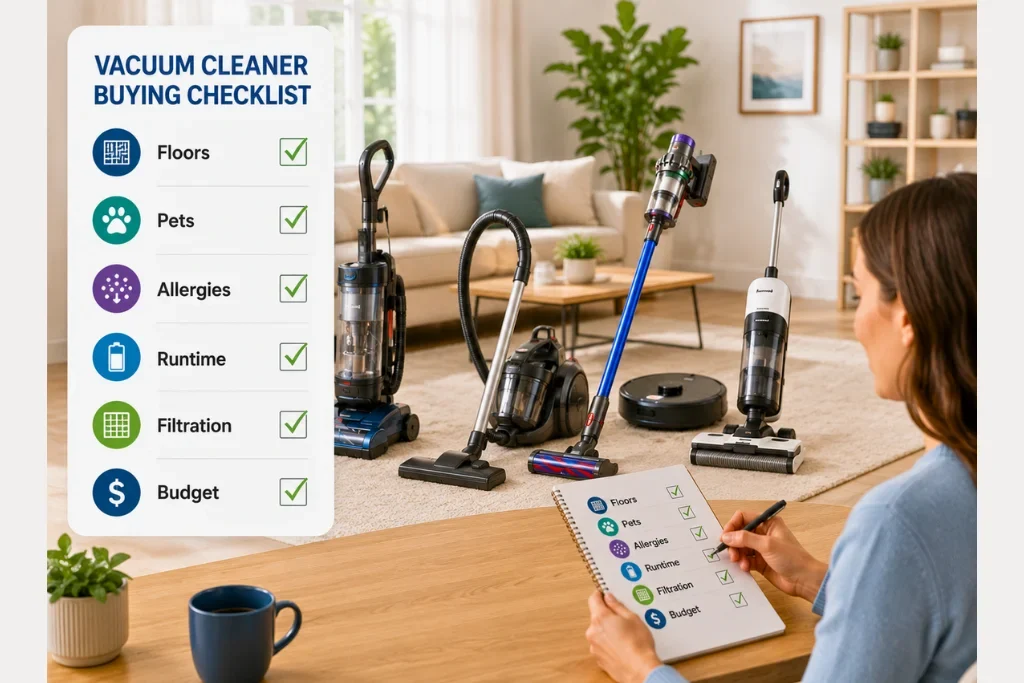
Use this checklist before buying:
- My main floor type is carpet, hard floor, or mixed flooring.
- My hardest mess is pet hair, dust, crumbs, sand, garage debris, or wet spills.
- I need a main vacuum, secondary vacuum, or maintenance cleaner.
- I need corded power or cordless convenience.
- I prefer bagged dust containment or bagless convenience.
- I need HEPA or sealed filtration.
- I can comfortably carry and store the vacuum.
- The dustbin or bag capacity fits my home size.
- The runtime or cord length fits my cleaning routine.
- Replacement filters, bags, batteries, and rollers are easy to buy.
- The attachments match my needs.
- The warranty and parts support are acceptable.
- The price makes sense after considering ownership cost.
Frequently Asked Questions
What type of vacuum cleaner is best for most homes?
For most homes, an upright or canister vacuum is the best main vacuum because it gives stronger deep-cleaning performance than most lightweight models. If convenience matters more than deep cleaning, a cordless stick vacuum is better for apartments and daily cleanup.
Is a cordless vacuum better than a corded vacuum?
A cordless vacuum is better for convenience, stairs, apartments, and quick messes. A corded vacuum is usually better for large homes, long cleaning sessions, and carpet-heavy spaces because it does not depend on battery runtime.
Are bagged vacuums better than bagless vacuums?
Bagged vacuums are usually better for dust containment and allergy-sensitive homes. Bagless vacuums are more convenient and avoid replacement bag costs, but emptying the dustbin can release more dust.
Do I need a HEPA vacuum cleaner?
You should consider a HEPA vacuum if you have allergies, pets, asthma sensitivity, or heavy dust. For the best result, choose a vacuum with both a HEPA filter and a sealed filtration system.
Can a robot vacuum replace a regular vacuum?
A robot vacuum can help maintain cleaner floors, but it usually does not replace a regular vacuum completely. Most homes still need a manual vacuum for stairs, furniture, corners, rugs, and deep carpet cleaning.
What vacuum cleaner is best for pet hair?
The best vacuum for pet hair should have strong airflow, an anti-tangle brush roll, a motorized pet tool, and sealed filtration. Pet owners with carpet should prioritize brush agitation, while hard-floor homes may benefit from a robot vacuum or cordless stick vacuum for daily hair control.
What vacuum is best for hardwood floors?
For hardwood floors, choose a vacuum with a soft roller, brush-roll shutoff, rubberized wheels, and strong fine-dust pickup. Canister vacuums, cordless stick vacuums, and hard-floor-friendly uprights are usually good choices.
How much should I spend on a vacuum cleaner?
Most buyers should focus on value rather than price alone. A good vacuum should match your floor type, cleaning frequency, filtration needs, and maintenance tolerance.
Where to Go Next
If you already know your biggest cleaning problem, start with the most relevant guide below:
- For pet hair, read Best Vacuum for Pet Hair.
- For hardwood and sealed floors, compare the Best Hardwood Floor Vacuums.
- For automated daily cleaning, read How to Choose a Robot Vacuum Complete Buying Guide.
- For garages and car detailing, compare the Best Shop Vacs for Garage & Workshop.
- For vacuuming and washing hard floors together, read Best Wet Dry Vacuum Mops for Pet Hair.
- Still comparing vacuum types? Read Cordless vs Corded Vacuum: Which One Should You Buy?
Start with the guide that matches your hardest cleaning problem first. That usually leads to a better long-term purchase.
Final Verdict: The Right Vacuum Cleaner Depends on Your Home
The best vacuum cleaner is the one that fits your floors, your messes, and your cleaning habits. Start with floor type, then consider pets, allergies, home size, runtime, dust capacity, filtration, and maintenance.
- For carpet-heavy homes, choose an upright or canister vacuum with a powered brush roll.
- For hardwood and sealed hard floors, choose a soft roller, brush-roll shutoff, or vacuum mop if you also want wet cleaning.
- For pet hair, prioritize brush design, filtration, and useful attachments.
- For garages and car detailing, choose a shop vac or wall-mount garage vacuum.
The simple rule is this: choose the vacuum for your hardest cleaning job first. Everything else becomes easier after that.


Engr. Hm Jamal is an electrical engineer and home systems expert with over 13 years of experience in appliance performance and water treatment. As the founder of Wits Engineer, he specialises in evaluating real-world performance, safety, and long-term reliability of home systems.